



Did You Know? Chocolate Has a Sense of Place
Most people recognise that wine can taste different depending on where the grapes are grown. A bottle produced in one region may offer flavours and aromas entirely different from those produced elsewhere. What many chocolate lovers may not realise is that chocolate shares a similar characteristic. The flavour of chocolate can be influenced by the environment in which cacao trees are grown, creating unique taste profiles from region to region.
This concept is known as terroir—a French term that describes how climate, soil, geography, and local growing conditions influence the character of an agricultural product. Just as vineyards produce distinctive wines, cacao-growing regions around the world create chocolates with remarkably different flavours.
What Is Chocolate Terroir?
Cacao trees thrive within a narrow band around the equator known as the “cacao belt.” This region stretches through parts of Central and South America, Africa, Asia, and the Pacific. Although cacao may be grown in all of these locations, the resulting beans can develop unique flavour characteristics based on their surroundings.
Factors such as rainfall, altitude, temperature, soil composition, and even nearby vegetation contribute to the flavour profile of cacao beans. Farming practices and fermentation methods further enhance these natural characteristics.
The result is a remarkable range of flavours that extend far beyond the simple description of “chocolate.”
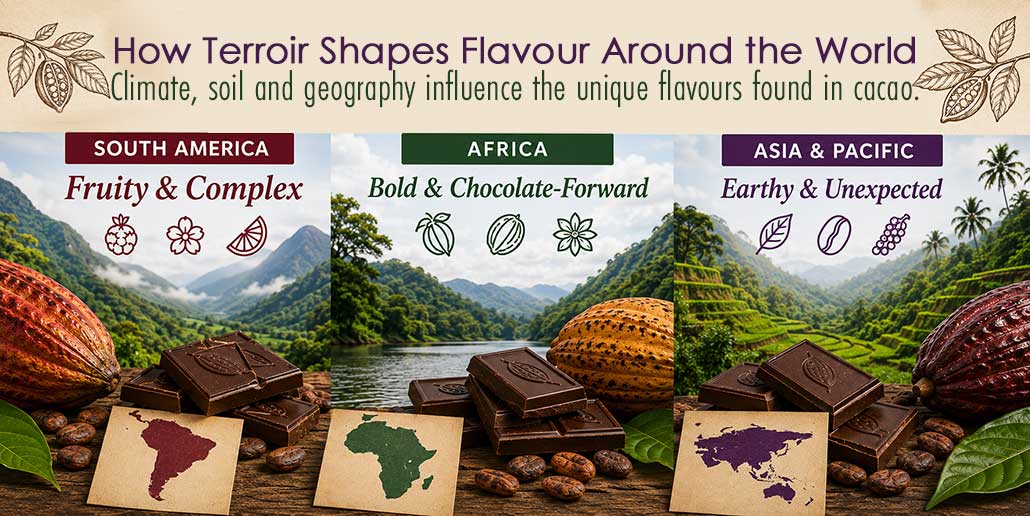
South America: Fruity and Complex
South America is often considered the birthplace of cacao. Countries such as Ecuador, Peru, Venezuela, and Colombia produce beans known for their complexity and refined flavour profiles.
Chocolate made from South American cacao frequently features notes of red berries, citrus, dried fruit, honey, and floral undertones. Some varieties may even reveal hints of jasmine, cherry, or tropical fruits.
Many premium chocolate makers seek out South American beans because of their distinctive flavour nuances and the region’s long history of cacao cultivation.
Africa: Bold and Chocolate-Forward
West Africa produces the majority of the world’s cacao, with countries such as Côte d’Ivoire and Ghana leading global production.
African cacao is often celebrated for its rich, robust chocolate flavour. Many beans from this region exhibit notes of roasted nuts, cocoa, caramel, and warm spices. These flavour profiles tend to be bold and familiar, making them popular for both premium and everyday chocolate products.
While African cacao may not always display the fruity characteristics associated with some South American varieties, its depth and consistency make it highly valued throughout the chocolate industry.
Asia and the Pacific: Earthy and Unexpected
The growing cacao regions of Asia and the Pacific have gained increasing recognition in recent years. Countries including Indonesia, Vietnam, the Philippines, and Papua New Guinea are producing exceptional cacao with distinctive flavour profiles.
Chocolate from these regions often features earthy, woody, smoky, or spice-driven notes. Some varieties reveal hints of black pepper, tropical fruits, tea, or roasted coffee.
As craft chocolate continues to grow in popularity, more consumers are discovering the unique flavours emerging from these exciting cacao-producing regions.
Why Single-Origin Chocolate Matters
The growing interest in chocolate terroir has helped fuel the popularity of single-origin chocolate.
Unlike mass-market chocolate, which often blends beans from multiple regions, single-origin chocolate is produced using cacao sourced from a specific country, region, or even a single farm. This allows the cacao’s natural flavour characteristics to shine through.
Craft chocolate makers often highlight the origin of their beans on packaging, encouraging consumers to explore the subtle differences between growing regions. For many chocolate enthusiasts, tasting single-origin bars is a journey of discovery, much like exploring wines from different vineyards.
How to Host a Chocolate Tasting at Home
Exploring chocolate terroir can be a fun and educational experience. Hosting a tasting at home requires only a few simple steps.
Choose three to five chocolate bars from different cacao-growing regions. Ideally, select bars with similar cocoa percentages to make flavour comparisons easier.
Begin by observing each chocolate’s appearance and aroma. Break off a small piece and allow it to melt slowly on the tongue rather than chewing immediately. Notice the flavours that develop over time.
Participants may detect notes of berries, nuts, caramel, coffee, spices, flowers, or dried fruit. There are no right or wrong answers—taste perception is highly personal.
Providing water and plain crackers between samples helps cleanse the palate and allows each chocolate’s unique characteristics to stand out.
A New Way to Experience Chocolate
Chocolate is far more than a sweet indulgence. Like wine, coffee, and tea, it reflects the environment in which it is grown. Climate, soil, geography, and local traditions all contribute to the final flavour experience.
Understanding chocolate terroir opens the door to a richer appreciation of one of the world’s favourite treats. The next time a chocolate bar lists its origin, readers may discover that they are tasting not just chocolate, but a unique expression of place.