Established: 1857
Home: Brussels, Belgium
Historic Innovation: Belgian praline, 1912
Packaging Innovation: Ballotin, 1915
Known for: Belgian pralines, Caprice and Tentation
Visit Neuhaus Chocolates




Neuhaus Chocolates
The Belgian Chocolate House That Invented the Praline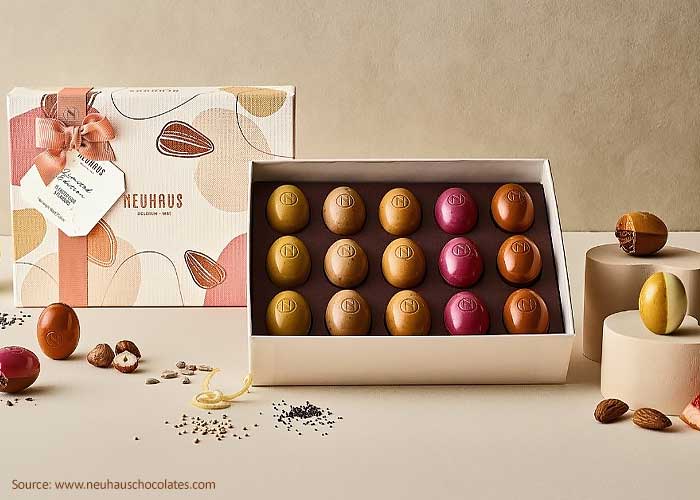

From a Brussels Pharmacy to a Belgian Chocolate Icon
The story of Neuhaus began in 1857, when Swiss-born Jean Neuhaus settled in Brussels and opened a pharmacy in the prestigious Galerie de la Reine. Alongside medicines, he sold confectionery and began covering medicines with chocolate to make them more pleasant for his customers.
More than 165 years later, the original Galerie de la Reine location remains part of Neuhaus, while the family name has become closely connected with one of Belgium’s most famous chocolate traditions.
The Invention of the Belgian Praline
The defining moment came in 1912. Jean Neuhaus Jr., grandson of the founder, transformed his grandfather’s original idea. Instead of placing medicine inside the chocolate shell, he filled it with something delicious.
The Belgian praline was born.
Unlike a solid piece of chocolate, the new creation combined a chocolate shell with a soft filling. Ganaches, pralines, creams and other centres could now become part of the chocolate experience. That innovation would help establish filled chocolates as one of the signatures of Belgian chocolate making.
The Ballotin Changes Chocolate Packaging
The praline soon created another challenge: how could these delicate chocolates be carried home without being damaged? In 1915, Louise Agostini, wife of Jean Neuhaus Jr., developed the ballotin, an elegant rectangular box designed specifically to protect the chocolates.
The solution proved remarkably enduring. More than a century later, the ballotin remains one of the most recognisable forms of chocolate packaging and is closely associated with Belgian pralines.
Together, the praline and ballotin became two important contributions by the Neuhaus family to modern chocolate culture.
Belgian Chocolate Made in Belgium
Neuhaus continues to make its pralines and truffles entirely in Belgium, at its atelier near Brussels. The company says its chocolates remain under the supervision of its Maîtres Chocolatiers and maintains a commitment to keeping production in Belgium.
The company’s best-known creations include Caprice and Tentation, developed for the 1958 World Exposition in Brussels. Caprice combines nougatine with Madagascar vanilla fresh cream and dark chocolate, while Tentation pairs nougatine with Arabica coffee ganache and milk chocolate.
These chocolates demonstrate how Neuhaus has continued developing new creations while maintaining its connection to traditional Belgian praline making.
Cacao, Ingredients and Traceability
Neuhaus says all of its cacao is sustainably sourced, and the company has invested in a cacao farm in Ecuador to establish a more direct connection with cacao growers and improve traceability and quality. The company also states that the ingredients used in its chocolates are of natural origin and that its chocolates are palm-oil free.
That focus connects a historic Belgian chocolate house with issues increasingly important to contemporary chocolate consumers: cacao origin, agricultural practices and greater transparency within the supply chain.
A Belgian Chocolate Legacy
Few chocolate houses can point to innovations that became part of the vocabulary of an entire chocolate culture. For Neuhaus, those contributions came remarkably early. The Belgian praline in 1912 changed what could be placed inside chocolate. The ballotin in 1915 changed how those chocolates could be protected and presented.
Yet Neuhaus has continued creating new chocolates rather than relying entirely on its history.
From the original Galerie de la Reine boutique to its Belgian atelier today, the house represents a particularly enduring connection between innovation, craftsmanship and Belgian chocolate tradition.