Founded: 1922
Home: Tain-l’Hermitage, France
Founder: Albéric Guironnet
Signature Chocolate: Guanaja 70%, created 1986
Professional School: L’École Valrhona, founded 1989
Known for: Couverture chocolate, cacao sourcing and professional pastry
Visit Valrhona




Valrhona
A Century of French Chocolate, Cacao and Pastry Innovation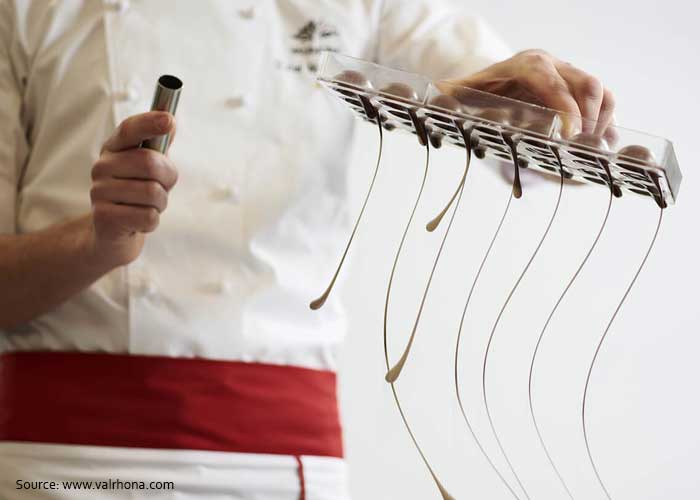

From the Rhône Valley to Professional Kitchens Around the World
The story of Valrhona began in 1922, when pastry chef and confectioner Albéric Guironnet established Chocolaterie du Vivarais in Tain-l’Hermitage, France.
Guironnet roasted his own cacao beans and began supplying chocolate to other artisans and pastry chefs. That early relationship with culinary professionals would become one of the defining characteristics of the company that eventually became Valrhona.
The Valrhôna name itself arrived in 1947, created as a contraction of Vallée du Rhône — the Rhône Valley that remains the company’s historic home. More than a century later, Valrhona remains closely connected to professional chocolate, pastry and gastronomy.
Guanaja Changes the Dark Chocolate Landscape
One of Valrhona’s most influential creations appeared in 1986. At the time, managing director Antoine Dodet challenged the company’s teams to create an exceptionally intense dark chocolate. The result was Guanaja 70%, which Valrhona describes as the world’s bitterest chocolate when it was introduced.
Its unusually high cacao percentage required the company to rethink how cacao was selected and blended. With less sugar available to mask imperfections, aromatic profiles became increasingly important.
Guanaja combined cacao characteristics associated with several origins, including Trinidad, the Dominican Republic, Jamaica, Ghana, Côte d’Ivoire and Madagascar. The chocolate became a benchmark for professional pastry and remains part of Valrhona’s collection four decades later.
Chocolate Made for Chefs
Valrhona’s relationship with chefs extends beyond supplying couverture. In 1989, the company founded L’École Valrhona in Tain-l’Hermitage to provide professional training in pastry and chocolate. The school has since expanded internationally, with locations in Paris, Tokyo, Brooklyn and Dubai.
Courses range from foundational chocolate and pastry skills to advanced professional techniques.
This exchange between chocolate maker and chef has become an important part of Valrhona’s identity. Professional feedback informs how chocolate performs in applications such as ganache, moulding, coating, pastry and frozen desserts, while the schools allow chefs to explore those possibilities directly.
Following Cacao Back to the Producer
Behind the professional chocolate is an extensive cacao-sourcing programme. Valrhona currently works with 16,979 cacao producers through partnerships with cooperatives, producer organisations and plantations in cacao-growing regions across Africa, Asia, the Caribbean and Central and South America.
Since 2018, 100 per cent of Valrhona’s cacao bean purchases have been traceable to the producer. The company has progressively expanded that work to individual farm plots, with 100 per cent of partner-producer plots mapped by the end of 2024.
Long-term relationships are central to the model. Valrhona says its cacao partnerships last at least three years and average more than eight years. That level of traceability allows the company to connect finished couverture with the farms and communities behind its cacao.
From Cacao Origin to Chocolate Flavour
Valrhona’s work with cacao has also helped develop a deeper emphasis on origin. Its sourcing teams work with growers on cultivation, fermentation and drying, recognising that decisions made at origin influence the flavour eventually experienced in chocolate.
In 1998, Valrhona introduced Gran Couva 64% Trinidad, its first chocolate produced from cacao associated with a single estate and vintage.
Today, the company works with cacao partners in countries including Madagascar, Venezuela, Ecuador, Peru, Brazil, Ghana, Belize, Haiti, Indonesia and the Dominican Republic, among others. This combination of sourcing and technical chocolate making has made cacao origin increasingly visible within a company once known primarily to professional chefs.
More Than a Century of Chocolate
Valrhona celebrated its 100th anniversary in 2022, marking a century since Albéric Guironnet began roasting cacao in Tain-l’Hermitage. Much has changed since that original workshop. Production has expanded, cacao sourcing has become international, and generations of pastry chefs have worked with Valrhona couverture.
Yet the relationship between those worlds remains central to the company. Cacao growers, chocolate makers and pastry professionals all influence what eventually reaches the plate.
For Valrhona, that connection may be its most enduring legacy: understanding fine chocolate not as the work of one person, but as a chain of expertise extending from the cacao farm to the pastry kitchen.