


The Great Cocoa Price Rollercoaster: What It Means for Canada’s Chocolate Industry
THE SWEET TAKEAWAY: 3 Things to Know
- Canada’s cocoa costs rose dramatically.
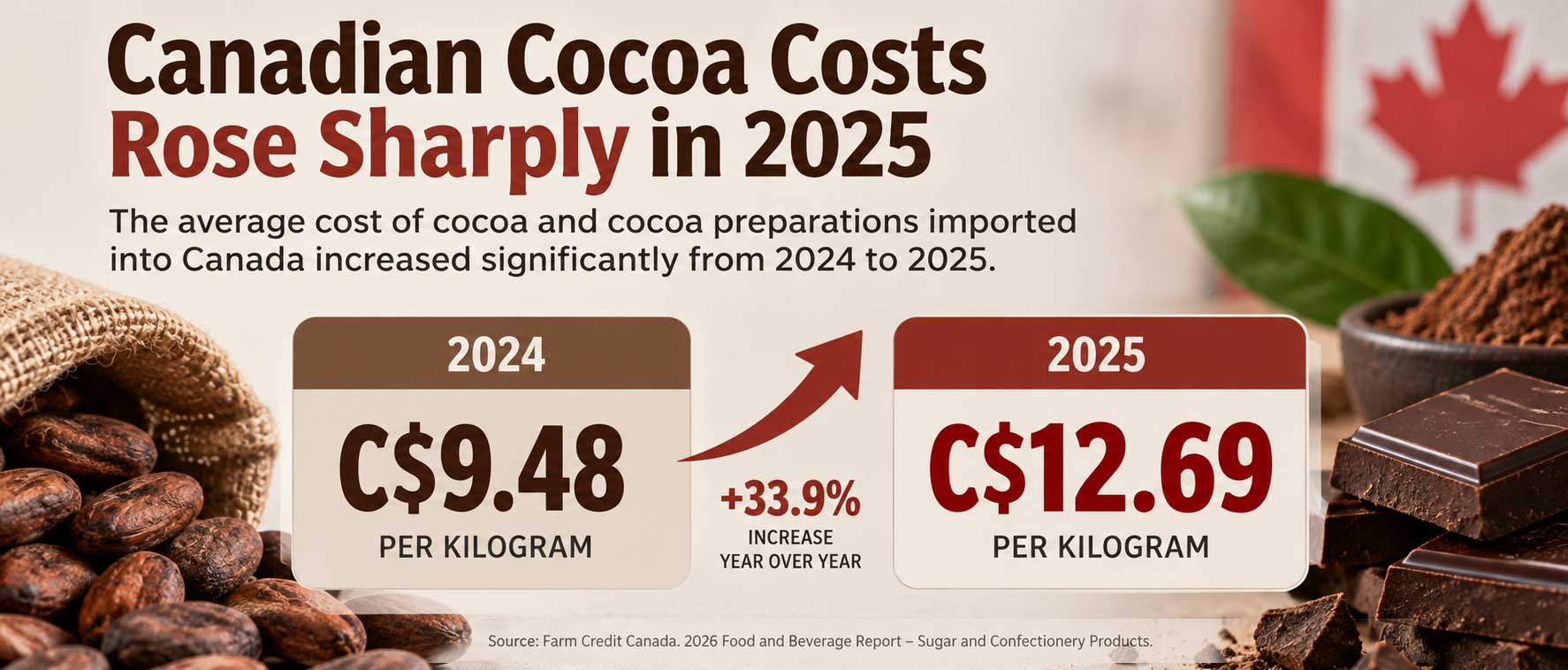
The average cost of imported cocoa and cocoa preparations increased from C$9.48/kg in 2024 to C$12.69/kg in 2025. - Global cocoa supplies are recovering.
World production for 2024/25 is now estimated at 4.733 million tonnes, an 8.5% increase from the previous season. - Cheaper cocoa doesn’t immediately mean cheaper chocolate.
Packaging, labour, transportation, energy and previously purchased ingredients continue to influence what Canadians pay.
Cocoa costs are easing, but Canadian chocolate makers and consumers are still feeling the effects of a historic global shortage.
For chocolate makers across Canada, the past few years have been anything but predictable. A historic cocoa shortage sent costs soaring in 2024 and early 2025, forcing manufacturers and independent chocolatiers to rethink everything from pricing and package sizes to sourcing and production.
The situation has improved considerably in 2026. Global cocoa supplies are recovering and commodity prices have retreated sharply from their peaks. But that does not mean Canada’s chocolate industry—or Canadian shoppers—has returned to where it was before the crisis.
Cocoa may be getting less expensive, but making chocolate is still costly. Understanding why requires looking beyond the price of the bean.
How Did Cocoa Become So Expensive?
Cacao is a tropical crop, and much of the world’s supply comes from a relatively small number of producing countries. When harvests suffer in major growing regions, the effects can quickly spread throughout the international chocolate industry.
That is exactly what happened during the cocoa crisis.
Poor weather, crop disease and other agricultural challenges reduced production, particularly in West Africa. With manufacturers competing for tighter supplies, cocoa prices climbed rapidly.
Canada was particularly exposed because cacao is not commercially grown here. Canadian manufacturers and chocolatiers rely on imported cocoa beans and processed cocoa ingredients to make their products.
Whether a company produces millions of chocolate bars or several hundred artisan bonbons, the raw material ultimately begins somewhere outside Canada.
The Canadian Cost of the Cocoa Crisis
One number illustrates the impact particularly well.
According to Farm Credit Canada’s 2026 Food and Beverage Report, the average cost of cocoa and cocoa preparations imported into Canada increased from C$9.48 per kilogram in 2024 to C$12.69 per kilogram in 2025. FCC describes that level as well above prices seen in previous years. (FCC)
For chocolate businesses, that increase could not simply be ignored.
Some manufacturers raised prices. Others adjusted portion or package sizes, absorbed part of the increase or reconsidered ingredients and product formulations. FCC notes that Canadian confectionery manufacturers had limited ability to pass every additional cost to shoppers whose household budgets were already under pressure.
Small chocolatiers faced an additional challenge. They generally purchase far less cocoa than major manufacturers, giving them less buying power when prices change dramatically.
Cocoa Supplies Are Recovering
There is encouraging news. The International Cocoa Organization‘s latest figures indicate that global production recovered during the 2024/25 cocoa season.
World cocoa production is estimated at 4.733 million tonnes, an increase of 8.5% from the previous season. Meanwhile, global cocoa grindings—a measure closely associated with the amount of cocoa being processed—declined 3.3% to 4.649 million tonnes.
Together, those changes produced an estimated global surplus of 37,000 tonnes.
Stocks also increased by almost 3% to approximately 1.309 million tonnes.
For Canadian chocolate businesses, improving global supply is welcome news. More available cocoa can ease some of the extreme purchasing pressure manufacturers experienced during the shortage.
But the recovery is still relatively young.
The ICCO cautions that the market remains highly responsive to changes in weather, demand and production conditions in major cocoa-growing countries.
Million Tonnes Global Production
Production Increase
Tonnes Estimated Surplus
So Why Is Chocolate Still Expensive?
This is probably the question that matters most to Canadian consumers. If cocoa prices have fallen, why hasn’t the price of a chocolate bar fallen with them?
Cocoa is only one part of the cost. Chocolate manufacturers also pay for sugar, milk ingredients, nuts, flavourings, packaging, labour, energy, transportation, equipment, warehousing and distribution.
Many businesses also purchase ingredients months in advance. Chocolate being manufactured today may therefore contain cocoa secured when prices were considerably higher.
Statistics Canada provides another indication of what shoppers experienced: confectionery prices increased 7.1% in Canada in 2025, while overall grocery prices increased 3.5%.
The commodity market can change quickly. A manufacturer’s cost structure generally cannot.
Canadian Chocolate Makers Are Adapting
The cocoa crisis has forced businesses to become more flexible. Some manufacturers have concentrated on improving efficiency and controlling waste. Others have adjusted product formats or portion sizes rather than passing the full increase directly to consumers.
FCC also identifies growing demand for premium, artisanal and sustainably sourced chocolate, including bean-to-bar products.
That trend creates an interesting opportunity for Canadian craft chocolatiers. Instead of competing primarily on price, smaller makers can emphasize craftsmanship, cacao origin, flavour, ethical sourcing and the experience surrounding the product.
For consumers willing to spend more on chocolate, knowing where it came from and how it was made can become part of its value.
The Industry Is Becoming More Resilient
One lasting effect of the cocoa crisis may be a greater focus on resilience. Chocolate companies have learned how quickly a problem thousands of kilometres away can affect production in Canada. That is encouraging manufacturers to think more carefully about suppliers, inventory, contracts and alternative ingredients.
Technology is playing a role as well. Better forecasting and data analysis can help manufacturers anticipate demand and avoid carrying unnecessary inventory during periods of volatile ingredient prices.
There is also growing interest in alternative chocolate technologies. FCC notes that lab-grown and alternative chocolate developments are attracting attention as possible long-term responses to cocoa supply volatility.
Traditional cacao isn’t disappearing, but innovation could eventually give manufacturers more options.
What Could Happen in 2027?
There are reasons for cautious optimism. FCC expects easing cocoa costs to support improved margins for Canadian sugar and confectionery manufacturers in 2026, provided weather conditions remain favourable and global stocks continue rebuilding.
But predicting chocolate prices a year ahead is much harder.
A poor harvest, extreme weather or renewed crop disease could tighten global supplies again. Canadian manufacturers must also contend with transportation, labour, energy and packaging expenses regardless of what happens to cocoa.
For shoppers, greater price stability may therefore be more realistic than dramatically cheaper chocolate in 2027.
What This Means for Canadian Chocolate Lovers
The cocoa rollercoaster is slowing, but its effects have not disappeared.
Canada’s chocolate businesses have endured one of the most challenging ingredient markets in recent memory. They have adjusted prices, products and sourcing strategies while consumers have become increasingly aware that producing chocolate is more complicated—and more expensive—than it once appeared.
The encouraging news is that global cocoa supplies are rebuilding.
For Canadian chocolate lovers, that should eventually mean a more predictable market, better supply availability and less pressure for sudden price increases.
The lesson of the past few years, however, will remain.
Chocolate begins with an agricultural crop grown far from Canada. Weather, farming conditions and global supply can ultimately affect everything from a handcrafted Canadian truffle to the chocolate bar in a grocery-store checkout.
And after one extraordinary cocoa rollercoaster, Canada’s chocolate industry is considerably more aware of the importance of being prepared for the next ride.