


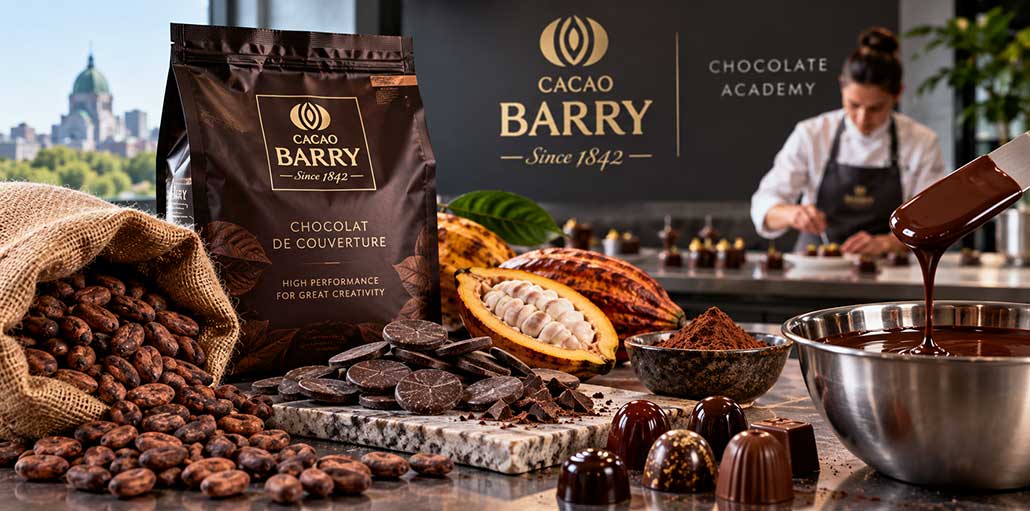
Cacao Barry: How a French Chocolate Pioneer Influences Canada’s Chocolate Industry
French Chocolate Heritage, Global Innovation and a Strong Canadian Presence
For generations of pastry chefs and chocolatiers, Cacao Barry has been more than a name on a bag of couverture. The French professional chocolate brand has helped shape the ingredients, techniques and education used by chocolate artisans around the world.
Its story began in Paris in 1842, when Charles Barry, originally a tea and coffee merchant, established the company and travelled to Africa in search of cacao beans for his first chocolate. Over the decades that followed, Cacao Barry expanded its involvement in cacao origins while developing products specifically for professional chocolatiers and pastry chefs.
Today, Cacao Barry is part of the Barry Callebaut Group, created in 1996 through the merger of French Cacao Barry and Belgian chocolate company Callebaut. The two brands retain separate identities: Cacao Barry remains rooted in French pastry and professional chocolate, while Barry Callebaut operates as the much larger global chocolate and cocoa manufacturer behind the brand.
From French Chocolate Heritage to a Global Professional Brand
Cacao Barry’s history includes several developments that influenced how professional chefs work with chocolate.
In 1952, it introduced a range of couverture chocolates specifically for artisans. In 1973, the company established professional training and support initiatives that evolved into today’s Chocolate Academy network. Moulds for professional chocolate work followed in 1976, while Pistoles, small pieces designed to make professional chocolate easier to measure and melt, arrived in 1988.
Cacao Barry expanded its exploration of origin with its Origines range in 1994, highlighting how cacao genetics and growing regions contribute different flavour characteristics to finished chocolate.
Couverture Designed for Chefs and Chocolatiers
Unlike consumer chocolate brands, Cacao Barry primarily serves professionals.
Its portfolio includes dark, milk and white couverture chocolates, origin chocolates, cacao powders, pralines, fillings and other ingredients used by chocolatiers, pâtissiers, bakers and chefs. The objective is not simply to produce a finished chocolate bar, but to provide professionals with ingredients they can transform into bonbons, pastries, desserts and other creations.
Innovation Beyond the Cacao Bean
Innovation continues to be part of Cacao Barry’s identity.
One notable example is Evocao WholeFruit Chocolate, introduced globally in 2021. Rather than relying primarily on the cacao bean, Evocao uses components of the cacao fruit and contains no refined sugar, lecithin or vanilla. Its sweetness comes naturally from the fruit. The product received the World Food Innovation Award for Best Artisan Product in 2022.
Cacao Barry has also participated in the Cocoa Horizons programme since 2020. The programme focuses on areas including cocoa-farmer prosperity, sustainable farming communities and environmental protection.
Supporting Canada’s Professional Chocolate Community
Cacao Barry has a meaningful presence in Canada through the wider Barry Callebaut organization.
Barry Callebaut Canada operates facilities in Saint-Hyacinthe, Quebec, and Chatham, Ontario, while Montreal is home to a Chocolate Academy Centre. The Montreal academy provides professional education in chocolate, pastry and confectionery through courses, demonstrations and hands-on training.
That educational role makes Cacao Barry particularly relevant to Canada’s chocolatier community. Chocolate Academy centres are designed as teaching and training environments where artisans and professionals can develop techniques, explore trends and work directly with chocolate.
Cacao Barry has also cultivated relationships with chefs through its international ambassador network and professional culinary programmes. Its presence therefore extends beyond supplying couverture; it participates in the exchange of techniques and knowledge that helps shape contemporary chocolate and pastry.