


Tariffs, Trade Wars & Chocolate: How Canadian Chocolatiers Are Adapting
THE SWEET TAKEAWAY: 3 Things to Know
- Canada’s tariff landscape has changed again.
New Canadian counter-tariffs of 15, 25 and 50 per cent on C$27.6 billion of targeted U.S. imports took effect on September 8, 2026. - Chocolate supply chains can change surprisingly quickly.
Lindt’s response to the 2025 tariffs demonstrated how a global chocolate company can reconsider whether products destined for Canada should be manufactured in the United States or Europe. - Canadian manufacturing could gain new opportunities.
Greater uncertainty surrounding cross-border trade gives manufacturers another reason to diversify supply chains and consider production closer to the markets they serve.
UPDATED SEPTEMBER 2026: Canada-U.S. trade measures continue to evolve. This article reflects tariff information available at the time of publication.
Changing trade rules are reshaping where chocolate is made, how it reaches Canada and what Canadian consumers may find on store shelves.
Canada’s chocolate industry is entering a new chapter, shaped not only by cocoa prices and consumer demand, but also by tariffs, changing trade rules and increasingly complicated North American supply chains.
The upheaval that began in 2025 demonstrated how quickly international trade policy can affect something as familiar as a chocolate bar. Manufacturers reconsidered where products destined for Canada should be made, retailers faced changing sourcing decisions and Canadian businesses found themselves navigating a marketplace where the rules could change with little warning.
Those pressures have not disappeared. In September 2026, Canada-U.S. trade tensions escalated again, bringing a new round of Canadian counter-tariffs and renewed uncertainty for businesses on both sides of the border.
For Canada’s chocolate industry, the lesson is becoming increasingly clear: where ingredients come from, where chocolate is manufactured and which border it crosses can matter almost as much as what is inside the package.
How Did Chocolate Get Caught in a Trade War?
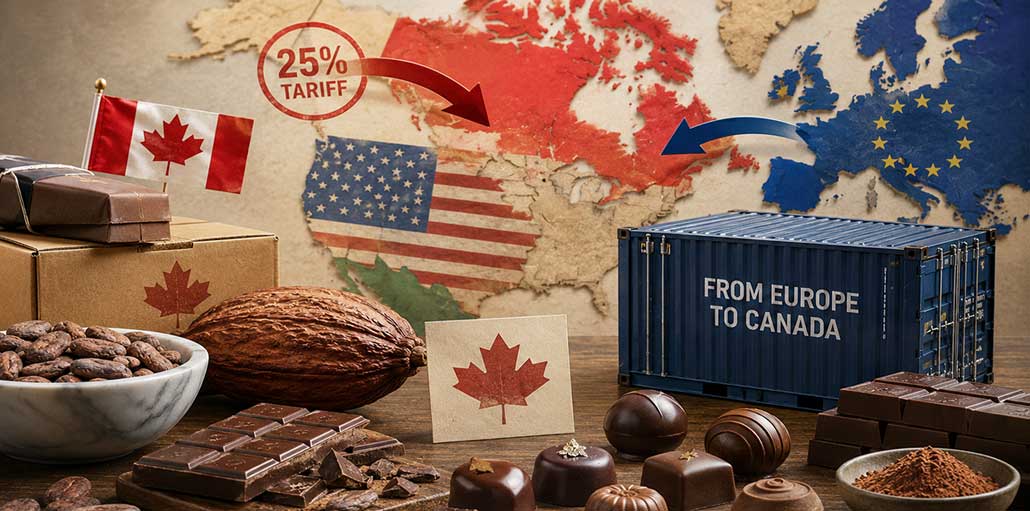
In March 2025, Canada imposed retaliatory tariffs on a wide range of U.S. goods after the United States introduced new tariffs affecting Canadian and Mexican imports. Chocolate suddenly became part of a much larger international trade story.
The effects extended beyond the products specifically named on tariff lists. Manufacturers also had to consider packaging, equipment, dairy ingredients, transportation and other inputs that could be affected directly or indirectly by changing trade rules. For companies operating factories in several countries, another question emerged: Does it still make financial sense to manufacture chocolate for Canadian consumers in the United States?
For at least one major chocolate company, the answer changed almost immediately.
The Lindt Example: When Chocolate Changes Countries
In March 2025, Swiss chocolate company Lindt & Sprüngli announced plans to shift chocolate destined for Canada away from its U.S. factories and supply the Canadian market from Europe.
At the time, approximately half of Lindt’s Canadian supply came from the United States, with the remainder coming from Europe. The company said transportation from Europe would cost more, but those additional shipping costs were still expected to be less expensive than the tariff impact.
It was an unusually visible example of something consumers rarely think about. A chocolate bar sitting on a Canadian store shelf may look exactly the same as it did six months earlier, while its production journey has changed by thousands of kilometres. The recipe may not have changed.
The supply chain did.
Canada’s Tariff Landscape Has Changed Again
The situation has continued to evolve. Effective September 8, 2026, Canada introduced counter-tariffs of 15, 25 and 50 per cent on C$27.6 billion of U.S. imports in response to new American trade measures.
The current measures are targeted primarily at sectors including steel, dairy, appliances, agricultural equipment, pulp and paper, plastics and electronics. That distinction matters.
Chocolate businesses are affected by much more than cocoa. A manufacturer may purchase dairy ingredients, machinery, refrigeration equipment, packaging materials or other products from international suppliers.
For a Canadian chocolatier, a tariff does not necessarily have to appear beside the word “chocolate” to affect the cost of doing business.
Why Tariffs Matter to Canadian Chocolate
Tariffs are often discussed in connection with automobiles, steel and large industrial sectors. Their effects on food manufacturing receive far less attention. But chocolate production involves a surprisingly complex network.
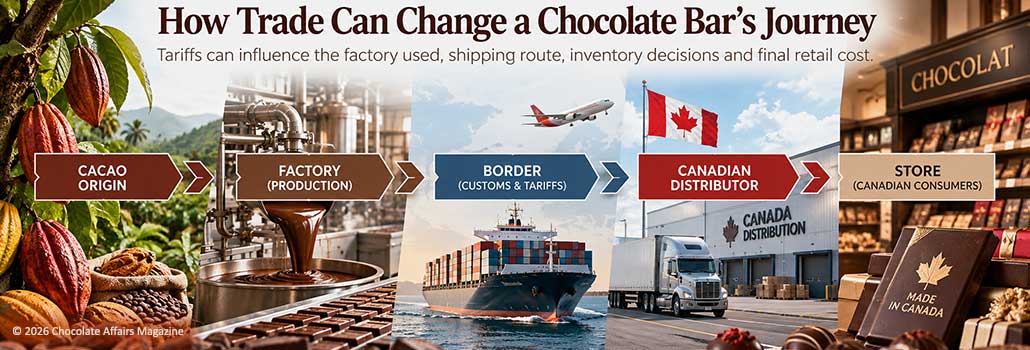
Cacao must reach Canada from tropical growing regions. Other ingredients may come from Canada or abroad. Packaging must be manufactured. Machinery must be maintained or replaced. Finished products must then move through warehouses and distribution networks before reaching retailers.
Add tariffs somewhere along that chain and businesses face choices. They can absorb the additional expense, find another supplier, change where something is manufactured or eventually pass part of the cost to consumers. Large multinational manufacturers may have several factories to choose from.
A small Canadian chocolatier usually doesn’t.
Could Canadian Manufacturers Gain an Advantage?
Trade disruption creates risks, but it can also create opportunities.
Canada already has an established food-processing sector and access to major North American consumer markets. Canadian chocolate manufacturers range from large-scale confectionery operations to specialist producers and internationally recognised bean-to-bar businesses.
When international companies reconsider their supply chains, Canadian production becomes part of the conversation. That doesn’t mean Canada is insulated from global trade.
Cacao still has to be imported, and manufacturers rely on international supply chains for numerous ingredients, equipment and materials. But greater domestic production can provide another layer of flexibility.
Opportunities for Canadian Chocolate Makers
Changing supply chains could create opportunities across several parts of Canada’s chocolate industry.
- Contract manufacturers
- Private-label producers
- Bean-to-bar makers.
- Specialty confectionery businesses
- And export-focused manufacturers.
The opportunity isn’t simply to replace imported chocolate. It is to build a stronger Canadian manufacturing base capable of serving domestic and international customers.

Small Chocolatiers Face a Different Challenge
For independent chocolatiers, the situation is more complicated. Instead, they must work within much tighter margins while managing cocoa costs, labour, packaging, transportation and other expenses. Seasonality adds another challenge.
Valentine’s Day, Easter and the winter holiday season can account for a significant portion of annual sales for some chocolate businesses. Unexpected increases in costs or interruptions in ingredient availability at the wrong time can therefore have an outsized effect.
For these businesses, flexibility in suppliers and careful inventory planning have become increasingly important. The trade war may be international, but its effects can eventually reach the neighbourhood chocolate shop.
What Canadian Shoppers May Notice
Most Canadians aren’t following tariff schedules when they buy chocolate. They are far more likely to notice what happens afterwards. That could mean changes in prices, package sizes, product availability or country-of-origin information.
There is another potential effect as well: greater visibility for Canadian products.
There is another potential effect as well: greater visibility for Canadian products. Reuters reported in September 2026 that changing consumer attitudes toward U.S. products are already influencing sourcing decisions within Canada’s grocery sector.
Building a More Resilient Canadian Chocolate Industry
The broader story is ultimately about resilience. The cocoa crisis demonstrated the danger of relying heavily on a concentrated agricultural supply. Trade disputes have now demonstrated how quickly established manufacturing and distribution routes can also be disrupted.
Chocolate companies cannot control international politics or the weather in cacao-growing regions. They can control how prepared they are.
Diversifying suppliers, maintaining appropriate inventory, strengthening relationships with producers and building flexible manufacturing arrangements can all reduce vulnerability.
For chocolate companies, diversification may ultimately mean more than finding another supplier. It could mean rethinking where products are manufactured, where ingredients originate and which markets businesses depend upon.
Where Does Canadian Chocolate Go From Here?
The future of Canada’s chocolate industry will be shaped by far more than flavour trends and seasonal demand. Cocoa availability, climate conditions, consumer behaviour and global trade policy are increasingly interconnected. That creates uncertainty, but it also creates an opening.
Canadian manufacturers have an opportunity to strengthen domestic production. Independent chocolatiers can capitalise on growing interest in Canadian-made products. Bean-to-bar makers can continue building direct international sourcing relationships while producing chocolate here at home.
For consumers, the changes may eventually result in more Canadian-made chocolate choices and greater awareness of where their favourite products actually come from.
And in today’s rapidly changing trade environment, adaptability may be one of the most valuable ingredients Canadian chocolate businesses have.