



From Europe to Canada: How Chocolate Supply Chains Are Being Rebuilt
Chocolate companies are rethinking where products are made and how they reach Canadian shelves.
For decades, the global chocolate industry relied on established routes. Cacao travelled from producing countries to processors and manufacturers, while finished chocolate moved through international distribution networks before reaching Canadian stores.
That system can work efficiently when global trade moves smoothly. However, tariffs, transportation disruptions, volatile cocoa costs and geopolitical uncertainty have exposed its vulnerabilities.
As a result, chocolate companies are reconsidering where products are manufactured, which factories supply particular markets and how much they should depend on any single country or transportation route.
For Canadian consumers, most of these decisions happen out of sight. Yet they can ultimately influence price, availability and even which chocolate products appear on store shelves.
Why Chocolate Supply Chains Are Changing
Chocolate has never had a simple supply chain.
Cacao is primarily grown in tropical regions, including West Africa and Latin America. The beans or processed cacao ingredients may then travel thousands of kilometres before becoming the chocolate bars, bonbons and other products consumers recognize.
Manufacturing and packaging can occur in yet another country. For years, companies focused heavily on making these networks as efficient and economical as possible. Recent disruptions have changed the conversation.
The question is no longer simply, “Where can this product be made most efficiently?”
Increasingly, companies must also ask, “Where should it be made to keep the supply chain reliable?”
That distinction is helping reshape the international chocolate business.
Lindt Reroutes Canadian Chocolate Through Europe
One of the clearest examples involves Swiss chocolate company Lindt & Sprüngli. In March 2025, Lindt revealed plans to change how it supplied the Canadian market. At the time, roughly half of its chocolate for Canada was coming from European production, while the remainder was supplied from the United States.
With Canadian tariffs threatening to make the U.S. route more expensive, Lindt said it intended to supply 100% of its Canadian chocolate from Europe by mid-2025.
Shipping chocolate across the Atlantic involves additional transportation costs compared with moving products across the Canada-U.S. border. However, Lindt determined that sourcing from Europe could make more economic sense than absorbing tariff costs.
For Canadian consumers, the chocolate on the shelf might appear largely unchanged. Behind the wrapper, however, its journey to Canada can be completely different.
Canada Is Part of the Manufacturing Equation Too
Supply-chain restructuring isn’t simply about importing more chocolate from Europe.
Canada itself is an important part of North America’s chocolate manufacturing network.
In April 2025, global chocolate and cocoa supplier Barry Callebaut announced plans for additional investment at its Brantford, Ontario facility while also expanding manufacturing capacity in the United States. The strategy reflected a broader effort to create greater flexibility within an increasingly complicated North American trading environment.
Changing U.S. tariffs also created an unexpected opportunity for manufacturers north of the border. By July 2025, tariffs applied to cocoa imported into the United States had created a potential cost advantage for chocolate manufacturers operating in Canada and Mexico.
Canadian chocolate exports to the United States had increased 10% through May 2025, according to reporting by Reuters. The development demonstrates how quickly trade policy can alter the economics of chocolate manufacturing.
A factory’s location is no longer simply about proximity to customers. Tariffs, ingredient costs, transportation and access to multiple markets can all influence where chocolate makes the most economic sense to produce.
Europe Already Matters to Canada’s Chocolate Supply
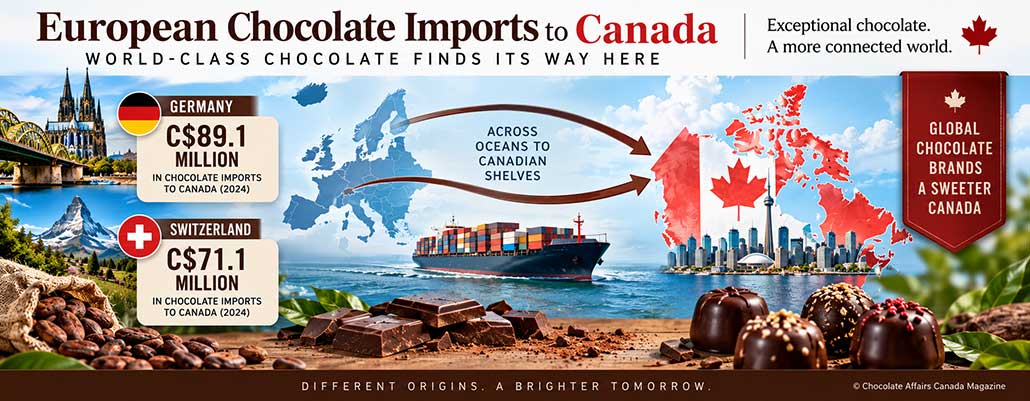
Lindt’s decision does not mean European chocolate suddenly began arriving in Canada. Europe is already an important part of Canada’s chocolate supply network. Canadian trade data show substantial imports of chocolate and cocoa-containing products from countries including Germany and Switzerland, two major European chocolate-producing markets.
In 2024, Canada imported approximately C$89.1 million from Germany within one broad category of chocolate and cocoa-containing food preparations. Major Canadian importers within that category included Ferrero Canada, Lindt & Sprüngli Canada and Storck Canada.
Another chocolate category recorded approximately C$71.1 million in Canadian imports from Switzerland during the same year.
Those figures provide a glimpse into how international the Canadian chocolate aisle already is. Chocolate sold under a familiar brand may have travelled through several countries before arriving at a Canadian retailer.
What It Means for Canadian Retailers
Having access to several manufacturing and sourcing locations can help companies respond when one route becomes more expensive or difficult. That flexibility can also benefit Canadian retailers.
If a manufacturer can supply Canada from more than one production facility, it may have additional options when tariffs, transportation problems or other disruptions affect its usual route. However, diversification also introduces complexity.
Longer transportation routes can mean additional freight costs and longer lead times. Currency fluctuations can affect the cost of imported products. Changing regulations and tariffs can make sourcing decisions more difficult. The result is a chocolate supply chain that may be more resilient, but not necessarily simpler.
What It Means for Chocolate Lovers
For most Canadians, these changes happen almost entirely behind the scenes. A familiar chocolate bar may remain on the same shelf, in the same wrapper and at the same retailer even though the route it travelled has changed dramatically.
Supply-chain decisions can nevertheless affect pricing, availability and product selection. They can also influence which varieties of an international chocolate brand are practical to sell in Canada.
A more flexible supply network may help companies keep products moving when one route encounters difficulties. However, it cannot eliminate every challenge, particularly when cocoa prices, transportation expenses and trade policies are changing at the same time.
Resilience Is Replacing the Shortest Route
For years, global supply chains were often designed around efficiency. The shortest, fastest or least expensive route could provide a competitive advantage. Today, having options is becoming increasingly valuable.
A chocolate manufacturer with access to factories, suppliers and distribution networks in several countries has more ways to respond when unexpected events make one route less attractive. That does not mean global chocolate supply chains are becoming simpler. They are becoming more flexible.
For the chocolate industry, that flexibility could prove essential as companies navigate volatile ingredient costs, changing trade relationships and unpredictable global events.
The Journey Behind the Wrapper
Chocolate sold in Canada has already travelled through an extraordinary international network before reaching the consumer. Cacao farming, ingredient processing, chocolate manufacturing, packaging, transportation, warehousing and retail can involve several countries. Now, the routes connecting those stages are changing.
Lindt’s decision to redirect Canadian supply through Europe demonstrates how quickly established manufacturing patterns can be reconsidered when trade conditions change. Meanwhile, investment in Canadian manufacturing shows that Canada itself can play an important role in the evolving North American chocolate network.
Canadian shoppers may never see most of these changes. But the next time a chocolate bar reaches a Canadian store shelf, one of its most interesting stories may be the journey it took to get there.